
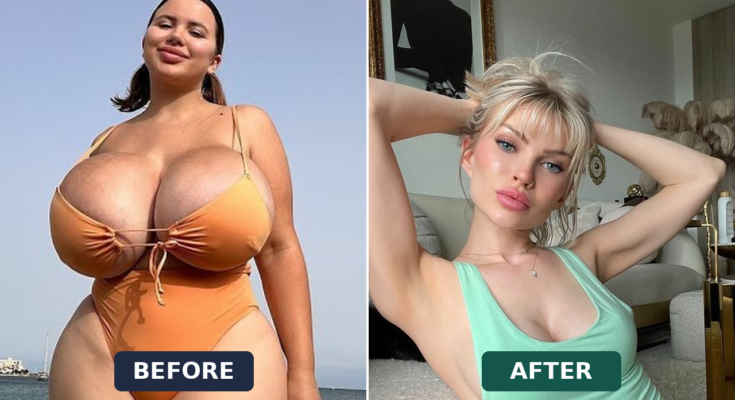

She Tried on Eight Shirts, but None Fit — The Heartbreaking Story of a 22-Year-Old Woman Who Carried 26 Pounds of Breast Tissue Before a Life-Changing Surgery

At just 22 years old, Marie Bunny was living through a medical nightmare that most people could hardly imagine. Her breasts had grown so dramatically that ordinary clothing no longer fit, strangers stared at her in public, and even a simple trip to the supermarket became humiliating. But the most shocking part of her story was still to come. After doctors discovered a rare medical condition, Marie would need an operation lasting more than ten hours — and an extraordinary act of kindness from strangers would help make it possible.
The Day Eight Shirts Changed Everything
Marie Bunny stood facing a problem that most young women never expect to encounter.
She needed a shirt.
Nothing expensive.
Nothing fashionable or extraordinary.
Just something comfortable enough to wear during an ordinary day.
But what should have been a simple shopping experience became one of the most upsetting moments of her young life.
She tried on one shirt.
It didn’t fit.
She tried another.
Still too small.
She reached for a larger size, hoping that would finally solve the problem.
But the fabric was still too tight across her chest.
One after another, the shirts failed to fit.
By the time Marie had tried eight different shirts, she was overwhelmed.
Not one had worked.
For someone who had previously worn a medium size, the experience was difficult to accept.
Her body had changed so dramatically that even the largest sizes she could find were no longer suitable.
And the most frightening part was that the changes were not stopping.
Her breasts were continuing to grow.
Marie was only 22 years old.
She was studying education in southern Brazil, preparing for a future that should have been filled with possibilities.
Instead, an unusual medical condition was beginning to control some of the simplest parts of her daily routine.
Getting dressed became difficult.
Finding a comfortable bra became nearly impossible.
Buying ordinary clothing was no longer straightforward.
Eventually, she needed garments made specifically for her body.
But even custom-made clothing came with uncertainty.
What if her breasts continued growing?
What if the clothes stopped fitting again?
How long would she have to live this way?
Marie did not yet have all the answers.
What she did know was that something extraordinary was happening to her body.
And before her journey was over, she would face medical examinations, a frightening possibility of cancer, public humiliation, financial difficulties, and a major operation.
But her story would also reveal something remarkable about human kindness.
The Changes Her Family Noticed
Marie lived in Mandirituba, a town near Curitiba in the Brazilian state of Paraná.
Like many young adults, she was focused on her studies and preparing for the next stage of her life.
In early 2024, however, members of her family began noticing an unusual physical change.
Her breasts appeared to be growing significantly.
At first, the transformation was not necessarily something that seemed alarming.
Bodies change naturally throughout life.
Weight fluctuations, hormonal changes, and other factors can affect breast size.
But what was happening to Marie was different.
The growth continued.
And as the months passed, it became increasingly difficult to ignore.
Clothes that had previously fit her were suddenly uncomfortable.
Bras that once provided support were no longer practical.
Even moving to larger clothing sizes did not solve the problem for long.
The situation gradually began affecting how she approached everyday activities.
Something as simple as choosing an outfit required additional thought.
Shopping for clothes could become frustrating.
And going out in public brought a different challenge.
People noticed her appearance.
Some stared.
Others pointed.
For Marie, the changes were no longer simply a private medical concern.
They were affecting how strangers treated her.
This is one of the most difficult aspects of living with a visible medical condition.
Other people can see that something is unusual without understanding the reason behind it.
They may make assumptions.
They may ask intrusive questions.
Sometimes, they may behave in ways that make an already difficult situation even worse.
Marie would soon experience that reality during an ordinary shopping trip.
And the incident would become one of the most memorable parts of her story.
The Supermarket Incident That Left Her Humiliated
Imagine going to a supermarket to buy groceries.
You walk through the aisles, choose the items you need, and prepare to pay.
It is an ordinary activity.
Something millions of people do every day without attracting attention.
But for Marie, one supermarket visit became an upsetting experience.
As her breasts continued growing, her appearance attracted increasing attention from strangers.
People stared at her.
Some pointed.
During one supermarket visit, she recalled that people suspected she was hiding merchandise around her chest.
The suspicion was connected to the unusual size of her breasts.
For Marie, it was deeply uncomfortable.
She was dealing with a medical condition she had not chosen.
Yet strangers were apparently interpreting her appearance as something suspicious.
Instead of simply being allowed to shop, she found herself subjected to unwanted scrutiny.
The incident illustrates a painful reality.
People sometimes judge what they do not understand.
They see something different and immediately form conclusions.
But appearances rarely tell the entire story.
Marie was not trying to attract attention.
She was not doing anything wrong.
She was a young woman struggling with a rare medical problem.
And the condition was already creating enough challenges without strangers making assumptions about her.
For someone experiencing unusual physical changes, moments like these can make public activities increasingly stressful.
A person may begin wondering whether people will stare whenever they leave home.
Whether someone will make a comment.
Whether an ordinary errand will become another uncomfortable experience.
Marie later spoke about the supermarket incident when explaining the difficulties she had faced.
It was one example of how her condition had begun affecting much more than her clothing.
But while strangers were focused on her appearance, Marie needed answers to a far more important question.
Why were her breasts growing so rapidly?
Doctors Considered a Frightening Possibility
As the growth continued, Marie sought medical help.
The changes were too significant to dismiss as an ordinary fluctuation in breast size.
Doctors needed to determine what was causing them.
During an early medical appointment, a clinician raised a frightening possibility.
Cancer.
For any patient, hearing that cancer might be involved can create enormous uncertainty.
For a 22-year-old already struggling with an unexplained physical transformation, it was another serious concern.
But a possible diagnosis is not the same as a confirmed one.
Marie underwent medical testing.
Doctors investigated the unusual growth.
Eventually, they ruled out a tumor.
That was an important development.
However, it did not mean her condition was harmless.
Her breasts were still growing.
The additional tissue was creating significant practical difficulties.
And she needed an explanation.
The final diagnosis was a rare medical condition known as gigantomastia.
The term may be unfamiliar to many people.
But for patients affected by severe cases, the consequences can be life-changing.
Gigantomastia involves excessive growth of breast tissue.
In some cases, the enlargement happens over a relatively short period.
The breasts can become extraordinarily large and heavy.
The additional weight may contribute to physical discomfort, posture problems, skin irritation, and difficulty with ordinary activities.
The exact causes are not always clear.
Some cases are associated with hormonal changes, pregnancy, puberty, medications, or other medical circumstances.
In other cases, no definite cause is identified.
The available account does not establish precisely what triggered Marie’s condition.
What is clear is that the growth became extreme.
And by the time she pursued treatment, the reported weight of her breasts was astonishing.
The Extraordinary Weight She Was Carrying
According to Marie’s account, her breasts eventually reached a combined weight of approximately 12 kilograms.
That is about 26 pounds.
Think about that number for a moment.
Twelve kilograms is heavier than many packed travel bags.
It is a substantial amount of weight.
Now imagine carrying that weight as part of your body throughout the day.
You cannot put it down when you become tired.
You cannot leave it on a chair.
You cannot remove it before going to sleep.
It remains there while you stand, walk, sit, and move.
For people with severe breast enlargement, the additional weight can place considerable demands on the body.
The neck, shoulders, and back may experience increased strain.
Finding comfortable sleeping positions may become difficult.
Physical movement can be restricted.
Clothing and supportive garments may no longer work as intended.
Not every patient experiences the same symptoms, and Marie’s account does not document every possible physical complication.
Nevertheless, the reported weight helps explain why her condition required serious medical attention.
This was not simply about wanting a different appearance.
It was about addressing an extraordinary amount of breast tissue that had become difficult to manage.
For months, Marie had been watching her body change.
She had struggled with clothing.
She had experienced unwanted public attention.
And now doctors had finally identified the medical condition responsible.
But receiving a diagnosis did not immediately solve the problem.
Treatment was still necessary.
And the next obstacle was one that many patients around the world understand all too well.
Money.
The Surgery She Needed Was Too Expensive
Doctors had identified a possible way forward.
Breast reduction surgery could remove a substantial amount of the excess tissue.
For Marie, the procedure offered hope of addressing the physical burden she had been carrying.
But the operation came with a significant financial challenge.
According to her account, private surgery would cost approximately 40,000 Brazilian reais.
That was far more than she could afford.
Marie was a young student living with her aunt at the time.
She did not have the financial resources to pay for such an expensive operation herself.
Brazil’s public healthcare system provided another possible route.
However, she faced a long waiting period.
That meant the medical problem could continue affecting her daily life while she waited for treatment.
It was a difficult situation.
She had a diagnosis.
She had a treatment option.
But accessing that treatment was not straightforward.
For many people, this is one of the most frustrating aspects of healthcare.
Knowing that a solution exists can bring hope.
But when treatment is expensive or difficult to access, that hope may be accompanied by uncertainty.
How long will the wait be?
Can the money be raised?
Will the condition continue getting worse?
Marie needed help.
And rather than keeping her struggle entirely private, she made a decision that would change everything.
She turned to television.
The Television Appearance That Changed Her Future
Marie approached a local television program in Curitiba.
Her goal was to explain her medical situation and seek help paying for the operation.
It was not an easy subject to discuss publicly.
She would have to speak openly about her body, the unusual growth, the difficulties she had experienced, and the surgery she needed.
These were deeply personal matters.
She had already experienced uncomfortable attention from strangers.
Now she was preparing to share her story with a much larger audience.
But this time, the attention would be different.
Instead of allowing people to judge her appearance without context, she had an opportunity to explain what was happening.
Viewers could hear about the rare diagnosis.
They could understand why ordinary clothing had become difficult to wear.
They could learn about the physical burden.
And they could see why treatment mattered so much.
Marie appeared live on the program.
She shared her experience.
She explained her need for surgery.
And viewers began responding.
What happened next was extraordinary.
Donations started coming in.
People who had never met Marie contributed money toward her operation.
The fundraising campaign gathered momentum rapidly.
And within approximately 20 minutes, viewers had donated enough to cover the reported cost.
Twenty minutes.
After months of difficulties, uncertainty, and financial obstacles, strangers had helped make the operation possible in less than half an hour.
It was a remarkable contrast with her earlier experiences.
At the supermarket, strangers had reportedly looked at her and made hurtful assumptions.
During the television appeal, strangers listened to her and offered practical help.
Both situations involved people who did not know her personally.
But one left her feeling humiliated.
The other opened the door to treatment.
The donations did not cure her condition.
They did not eliminate the risks of surgery.
But they removed a major financial barrier.
And for Marie, that meant the next stage of her journey could finally begin.
More Than Ten Hours in the Operating Room
On October 25, 2024, Marie underwent breast reduction surgery.
The procedure lasted more than ten hours.
During the operation, surgeons removed approximately 10 kilograms of breast tissue.
That is about 22 pounds.
The amount removed was extraordinary.
It represented a substantial reduction in the tissue she had been carrying.
Major breast reduction surgery requires careful planning and medical expertise.
Surgeons must consider blood supply, tissue removal, wound closure, and the patient’s safety throughout the procedure.
The exact surgical method used in Marie’s case was not fully detailed in the account.
But the reported duration and amount of tissue removed demonstrate the scale of the operation.
More than ten hours is a long time to spend in surgery.
And although the procedure was an important step, recovery would still be necessary.
Marie was discharged from the hospital the following day.
She returned home to begin healing.
After extensive breast reduction, patients may need time for swelling to decrease, wounds to heal, and physical activity to return gradually to normal.
Follow-up care is important.
The original account does not provide a complete long-term medical update.
But Marie did share something deeply personal about the early period after surgery.
She spoke about looking at herself in the mirror.
And sometimes, she cried.
Not because another shirt had failed to fit.
But because she found it difficult to believe she had finally made it through the operation.
The Emotional Moment in Front of the Mirror
For months, Marie had watched her body change in ways she could not control.
Her breasts had grown dramatically.
Clothing had become increasingly difficult to find.
Public attention had made ordinary outings uncomfortable.
And obtaining treatment had required an extraordinary effort.
Now, after surgery, she could see the results of the procedure she had worked so hard to obtain.
Marie later described feeling beautiful when she looked at herself.
She also said she sometimes cried because she could hardly believe the operation had finally happened.
It was an emotional milestone.
The mirror had once been associated with frustration.
It reflected a body that was changing rapidly and creating practical difficulties.
Now it reflected the beginning of a different stage in her life.
Her reaction was not simply about appearance.
It was connected to everything she had experienced.
The uncertainty.
The medical examinations.
The financial struggle.
The television appeal.
The generosity of strangers.
And the long operation.
All of those events had led to this moment.
It is important to recognize that a person’s beauty or worth is never determined by breast size.
People of every body type deserve dignity and respect.
But Marie had been living with a medical condition that significantly affected her daily life.
She had chosen to pursue treatment.
And she was expressing happiness with the changes she could see.
That personal satisfaction was meaningful.
She was still recovering.
There were still medical instructions to follow.
But she had reached a milestone that once seemed difficult to achieve.
And when she began speaking about her future, her wishes were surprisingly simple.
The Beach Trip She Had Been Dreaming About
After everything Marie had experienced, what did she want to do next?
Her plans were not extravagant.
She wanted to wear her own clothes again.
She wanted to put on a bikini.
And she wanted to go to the beach.
For many people, these are ordinary activities.
They might not seem particularly important.
But for Marie, they represented the possibility of returning to experiences that her condition had made difficult.
Think back to the beginning of her story.
Eight shirts.
None of them fit.
Even the largest sizes were too small across her chest.
She had needed custom-made clothing.
And there was no certainty that those garments would continue fitting as her breasts grew.
Now she was looking forward to choosing swimwear and enjoying a day at the beach.
The original account does not confirm that she had already taken the trip.
She was still recovering when she spoke about those plans.
But the fact that she could look forward to them was significant.
The future no longer revolved only around finding larger clothing or obtaining surgery.
She could begin imagining ordinary pleasures again.
A day outdoors.
A swimsuit she wanted to wear.
Time spent by the water.
These may seem like small things.
But when a medical condition interferes with daily life, regaining ordinary choices can feel extraordinary.
The Lesson Behind Her Remarkable Journey
Marie’s story attracted attention because of the unusual medical condition and the extraordinary amount of tissue removed during surgery.
But there is a deeper message behind the headlines.
It is about what happens when someone develops a visible condition that other people do not understand.
Marie experienced unwanted attention.
She faced assumptions about her appearance.
She struggled with activities that most people take for granted.
And she encountered financial barriers while trying to obtain treatment.
Yet her experience also showed the power of community support.
When she explained her situation publicly, viewers responded.
In approximately 20 minutes, they helped raise enough money for an operation she could not afford on her own.
Their generosity helped make treatment possible.
Her story also reminds us that appearances can be misleading.
A person may look unusual because of a medical condition that is invisible in every other respect.
Strangers may notice the difference without understanding its cause.
That is why compassion matters.
Nobody should have to explain a private health problem simply to be treated with respect.
And nobody should be humiliated because their body looks different.
Marie’s experience demonstrates that curiosity should never replace kindness.
It also shows why unusual physical changes deserve appropriate medical evaluation.
Rapid or unexplained breast growth can have several causes.
Not every case is gigantomastia.
And treatment must be individualized.
But for people experiencing severe symptoms, medical care can make a meaningful difference.
From Eight Shirts to a New Beginning
There are two pieces of clothing that capture the transformation in Marie Bunny’s story.
The first is the eighth shirt.
The one she tried after seven others had already failed to fit.
It represented months of frustration.
A body that continued changing.
A medical condition she was struggling to understand.
And the difficulty of performing something as ordinary as getting dressed.
The second is the bikini she hoped to wear after surgery.
It represented something very different.
Possibility.
Comfort.
A future with fewer practical limitations.
And the opportunity to enjoy an ordinary day at the beach.
Between those two moments, Marie experienced an extraordinary journey.
Her family noticed the unusual growth.
Doctors investigated and eventually diagnosed gigantomastia.
Her breasts reportedly reached a combined weight of approximately 12 kilograms.
She struggled to find clothing and experienced uncomfortable public attention.
The cost of private surgery presented another challenge.
Then a television appeal brought unexpected support.
Viewers raised enough money in about 20 minutes.
On October 25, 2024, surgeons removed approximately ten kilograms of breast tissue during an operation lasting more than ten hours.
Afterward, Marie began recovering and spoke emotionally about seeing herself in the mirror.
She was looking forward to wearing her own clothes again.
And she was dreaming of the beach.
Her story is not simply about a rare medical diagnosis.
It is about the difficulties that can arise when a person’s body changes beyond their control.
It is about the importance of receiving appropriate treatment.
It is about the harm caused by public judgment.
And it is about the difference that kindness can make when someone needs help.
Marie had once stood in a clothing store unable to find a single shirt that fit.
Months later, she was looking toward a future in which choosing what to wear might finally become simple again.
Sometimes, the most meaningful changes in life are not about achieving something extraordinary.
Sometimes, they are about getting back the ordinary moments that a medical condition once made difficult.
And for Marie Bunny, the hope of wearing a bikini and spending a day at the beach represented exactly that.
What Do You Think?
Marie faced public humiliation because of a rare medical condition, but strangers later helped raise enough money for her surgery in just 20 minutes.
Which part of her journey moved you the most — her struggle with the condition, the kindness of the people who donated, or her happiness after surgery?
Share your thoughts and remember: behind every unusual appearance may be a personal story that deserves understanding rather than judgment.